
2nd
Round robin activity for Granular Flow problem
Background
The discrete element method
is a powerful tool for understanding various fundamental behaviors in
geomechanics at a microscopic level. This method can be used to simulate
boundary-value problems in geotechnics. Although its potential is acknowledged,
several issues with this method remain. One issue is how to verify simulation
results objectively. One solution is to develop several appropriate benchmarks.
The benchmark could be developed by executing a round-robin activity.
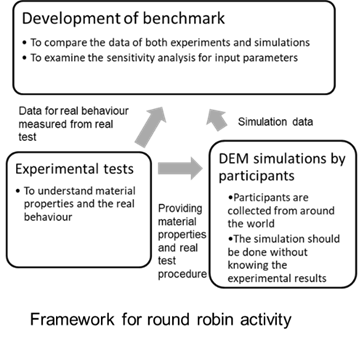
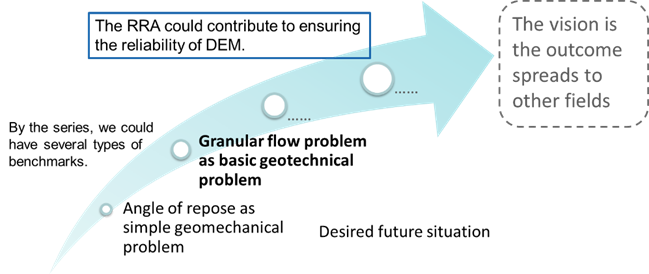
Since 2019, the organizers
have conducted the 1st round robin activity for the Angle of Repose test.
The details can be accessed
through https://ds.cc.yamaguchi-u.ac.jp/~geotech/tc105/ , with two published
papers:
experimental aspects: https://doi.org/10.1016/j.sandf.2022.101178 and
simulation
aspects: https://doi.org/10.1016/j.sandf.2023.101272.
Now, the TC105 Japanese
domestic committee is preparing to conduct the 2nd round robin
activity for DEM. To develop a reliable benchmark effectively, many simulation
results from multiple participants are needed. We would like to invite you to
participate in the round robin activity and look forward to your contributions!
2nd RRA for
Granular Flow problem of 3D printed particles
Granular flow is a type of
slope failure in geotechnical engineering and involves the movement of
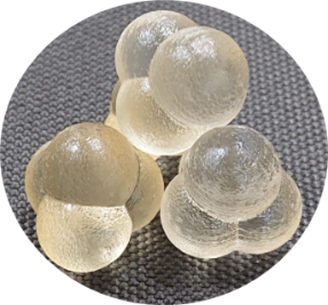
individual particles. The problem is tested using the same 3D-printed particles
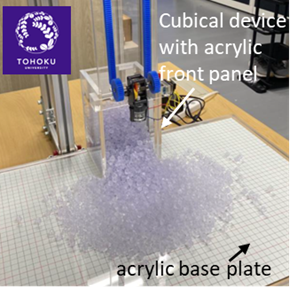
and the cubical device utilized in the 1st RRA.
PARTICLE SHAPE AND MATERIAL PROPERTIES[PDF] & EXPERIMENTAL DEVICE[PDF]
The experiments were
carried out using the cubical device placed on an
acrylic baseboard. The 2nd RRA featured experiments conducted at four different
laboratories. Each laboratory conducted the test 30 times.
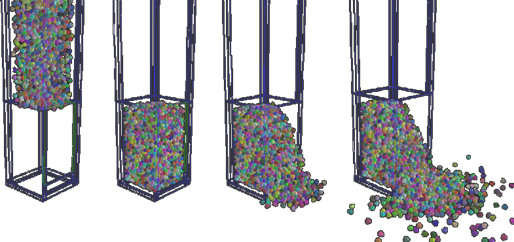
The granular flow test was
initiated by pulling up the front acrylic panel at a constant speed. The mean
of four institutions is 0.0645m/s. 3,535 particles inside the device flowed out
under their own weight and spread out on the acrylic plate.
EXPERIMENT METHOD[PDF] & PARTICLE STORAGE APPARATUS
[PDF]
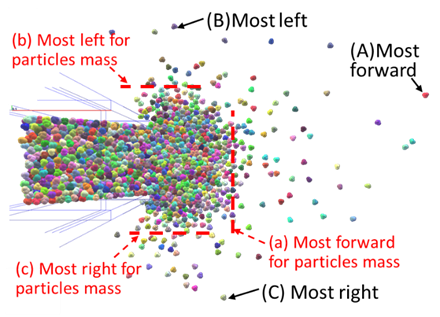
The measurements were
analyzed, focusing on the front and bulk tips along the X-Y plane. The front
tip defines the position of the furthest isolated particle (A, B & C),
while the bulk front describes the tip of the continuous main cluster of
particles (a, b & c).
MEASUREMENT[PDF]
Let’s join 2nd RRA
The organizers hope that
many participants will join this activity to simulate granular flow problems.
Participants are requested
to run the simulation 30 times (recommended: 50) and to submit the
location information (xyz coordinates) of all
particles in the start and end states for each result. The organizers will
analyze the submitted location information. Please pay close attention to
the coordinate system. Unlike the first RRA, the
origin (0,0,0) is now set at the center-bottom of the gate, exactly on the
baseboard surface. Most importantly, we have aligned the X-axis with the
direction of the granular flow. This is essential for our analysis of the flow
distance.
COORDINATES SETTINGS [PDF], EXPERIMENTAL PROCEDURE[PDF]& SUBMISSION INSTRUCTIONS [PDF]
[Download the EXCEL file
for reporting the simulation condition [EXCEL]]
The simulation should be
run based on the material properties and detailed experimental procedures
provided through the HP. The important point is that
the simulation should be performed without knowledge of the experimental
results. Therefore, facilitating what is commonly referred to as a blind
analysis, where the results of the experiment are estimated numerically based solely
on the various conditions of the experiment. Participants are encouraged to
simulate the angle of repose of the first RRA and check the validity of their
simulations.
The results of this
analysis will be published anonymously and, if all goes as planned, summarized
for publication in a journal article similar to the
first round. The participants will be listed as co-authors of the simulation
paper.
Submission of Simulation
Data and Data Usage Agreement
All participating groups
submitting simulation data are required to review the instructions and submit
the Zip file explained in the instruction and the “Data Usage Agreement.” This
agreement clarifies the policies regarding data handling, authorship for future
publications, and rules for data reuse.
Please download the
agreement below, complete the required information, and sign it.
[Download Data Usage Agreement[PDF/Word]]
Schedule
Spring, 2026, Announcement
for participating
30 September 2026,
Submission of outcome for 2nd RR
Spring, 2027, Open for the
outcome of 2nd RR
SUBMISSION OF ZIP files and
AGREEMENT
Shuji Moriguchi, Secretary of the Japanese
domestic committee, shuji.moriguchi.d6@tohoku.ac.jp